
Like so many of his predecessors, President Obama is quickly discovering that persuading Israel to change course is nearly impossible.
Obama came to office determined to achieve a two-state solution between Israelis and Palestinians. His opening move was to insist that Israel stop building settlements in the West Bank and East Jerusalem -- a tough line aimed at bolstering Palestinian President Mahmoud Abbas and persuading key Arab states to make conciliatory gestures toward Israel. These steps would pave the way for the creation of a viable Palestinian state and the normalization of Israel's relations with its Arab neighbors, and also help rebuild America's image in the Arab and Muslim world.
Unfortunately, Israeli Prime Minister Binyamin Netanyahu has no interest in a two-state solution, much less ending settlement expansion. He and his government want a "greater Israel," which means maintaining effective control of the West Bank and Gaza. His response to Obama's initiative has ranged from foot-dragging to outright defiance, with little pushback from Washington. MORE in the Washington Post
Friday, September 18, 2009


Thursday, September 17, 2009
80 Yemeni's killed in air strike
More than 80 people, including a large number of civilian refugees, were killed in a government air strike in northern Yemen Wednesday as they sought shelter from a month-long conflict between the military and rebel forces, tribal leaders said.
Local and international human rights groups have condemned the attack, which appeared to be the deadliest single episode in a worsening war between government forces and the Houthi rebels in Yemen’s remote and mountainous north.
It was not immediately possible to independently confirm the numbers killed. MORE in the New York Times
Sunday, September 13, 2009
Recaiming the Christian faith from the Western World
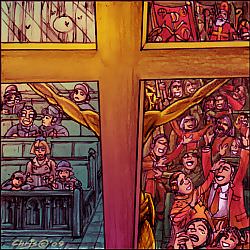
But this was no ordinary iftar invitation. Issam Darwich is the local Bishop of the Melkite Catholic Community. Yet if Bishop Darwich telephoned a talkback radio station and announced he was holding an iftar for Ramadan, what would listeners assume to be his religious affiliation? MORE HERE
Saturday, September 12, 2009
Saudi Arabia fears its Jewish and Christian past
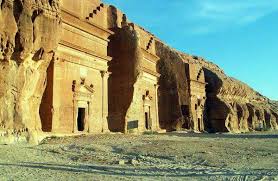 Much of the world knows Petra, the ancient ruin in modern-day Jordan that is celebrated in poetry as "the rose-red city, 'half as old as time,'" and which provided the climactic backdrop for "Indiana Jones and the Last Crusade."
But far fewer know Madain Saleh (see picture), a similarly spectacular treasure built by the same civilization, the Nabateans.
That's because it's in Saudi Arabia, where conservatives are deeply hostile to pagan, Jewish and Christian sites that predate the founding of Islam in the 7th century.
But now, in a quiet but notable change of course, the kingdom has opened up an archaeology boom by allowing Saudi and foreign archaeologists to explore cities and trade routes long lost in the desert.
The sensitivities run deep. Archaeologists are cautioned not to talk about pre-Islamic finds outside scholarly literature. Few ancient treasures are on display, and no Christian or Jewish relics. A 4th or 5th century church in eastern Saudi Arabia has been fenced off ever since its accidental discovery 20 years ago and its exact whereabouts kept secret. MORE HERE
Church in Pakistan up in flames
An angry mob torched a church in Sambarial area of Sialkot over alleged desecration of the holy Quran, a private TV channel reported on Friday. According to the channel, a Christian boy snatched the holy Quran from a 10-year-old girl and allegedly disrespected it.
After the incident, an infuriated mob set a church on fire. Police cordoned off the area to prevent any untoward incident, the channel reported. Early last month, a Muslim mob had attacked a Christian neighbourhood in Gojra over reported desecration of the holy Quran in a nearby village.
Federal Minority Affairs Minister Shahbaz Bhatti has condemned the incident and directed the police and authorities to arrest the perpetrators and submit a report within 24 hours. (c) Daily Times Pakistan
Egypt killing many who try to cross border to Israel
Egyptian authorities should bring an immediate end to the unlawful killings of migrants and asylum seekers near Egypt’s Sinai border with Israel, Human Rights Watch said today. According to news reports, Egyptian border guards shot and killed four migrants on September 9, 2009, bringing to at least 12 the number killed since May as they tried to cross into Israel.
General Muhammad Shousha, the governor of North Sinai, was quoted after the recent killings justifying the policy of shooting at the migrants as “necessary.” The latest killings come just days before President Hosni Mubarak of Egypt and Prime Minister Benjamin Netanyahu of Israel are scheduled to hold high-level talks in Cairo on September 13.
“Egypt has every right to manage its borders, but using routine lethal force against unarmed migrants – and potential asylum seekers – would be a serious violation of the right to life,” said Joe Stork, deputy Middle East director at Human Rights Watch. “These individuals appeared to post no threat to the lives of the border guards or anyone else. Attempted border crossings are not a capital offense.”
MORE HERE
Friday, September 11, 2009
Fatefull schism in Islam
 The Wall Street Journal has a book review by Eric Ormsby on After the Prophet by Middle East journalist Lesley Hazleton. It deals with the Sunni-Shia schism that developed after Muhammad died; a schism that still haunts Islam and the world.
When the Prophet Muhammad died unexpectedly after a brief illness in Medina, in present-day Saudi Arabia, on June 8, 632, his followers were stunned. A contemporary called it "the greatest of calamities." Their grief was not only for the loss of an irreplaceable leader. Muhammad was "the seal of the prophets," the last in a line that stretched back to Adam. He had received revelations as "God's emissary" for some 20 years—revelations that he had communicated to the embattled community of his followers, first in Mecca and then, after the hijra, or emigration, in 622, in Medina—but now they came to an end. It was as though God, who revealed Himself through the Prophet, had suddenly fallen silent.MORE HERE
Subscribe to:
Posts (Atom)


